
Minimally Invasive Cardiac Surgery in Lucknow: Benefits, Risks and Recovery
By Dr. Rahul Bhushan | Cardiac & MICS Surgeon | Lucknow
Introduction
Hearing that you need heart surgery is difficult enough. Many patients then ask whether the operation can be done through a smaller cut. Minimally invasive cardiac surgery is an option for some heart conditions, including selected bypass and valve procedures. It can reduce the disruption caused by opening the breastbone, but suitability depends on the operation needed and the person’s health.
Minimally Invasive Cardiac Surgery (MICS)?
MICS is the short name for minimally invasive cardiac surgery. You may see it on a hospital website or hear it during a consultation. It covers different operations performed through smaller chest cuts; it is not the name of one specific procedure. Ask your surgeon which operation they mean when they recommend MICS.
What does minimally invasive heart surgery mean?
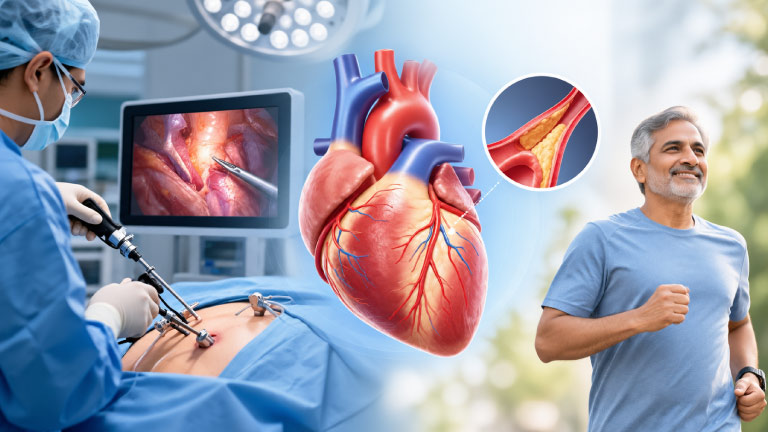
In conventional open-heart surgery, the surgeon generally opens the breastbone to reach the heart. In a minimally invasive approach, the surgeon works through smaller cuts, often between the ribs at the side of the chest. A camera and specialised instruments may help the team see and perform the procedure. Some operations use robotic assistance. The exact method varies by condition and surgical plan.
“Minimally invasive” describes how the surgeon reaches the heart. It does not mean the condition is minor. These are still major operations requiring anaesthesia, a trained surgical team and careful recovery.
It is also different from angioplasty. Angioplasty treats a coronary artery through a catheter passed into a blood vessel; minimally invasive bypass surgery is an operation that creates a new path for blood around a blockage.
MICS vs Open-Heart Surgery
The main difference is how the surgeon reaches the heart. Conventional surgery usually involves opening the breastbone, while MICS generally uses cuts between the ribs. The best approach depends on whether the surgeon can reach and treat every area that needs attention. A smaller cut is useful only if it allows the required operation to be done safely and effectively.
Which heart problems may be treated this way?
Depending on the patient and the surgical team’s assessment, minimally invasive techniques may be used for selected coronary bypass operations, heart valve repair or replacement, and certain other heart procedures. The fact that a procedure can be performed through smaller cuts does not mean every patient with that diagnosis is a candidate.
For example, someone considering minimally invasive bypass surgery in Lucknow needs an assessment of the coronary arteries and the proposed grafts. For valve surgery, the type of valve disease and any other heart problems also affect the plan. The surgeon must be able to complete the necessary repair or bypass safely and effectively.
Who Is an Ideal Candidate for MICS Surgery?
There is no single profile that makes someone an ideal candidate. The surgeon looks at the operation required, heart scans, previous procedures and other health conditions. MICS may be suitable when the affected area can be reached and the full operation can be completed through smaller cuts. The assessment is individual, even when two patients have the same diagnosis.
What are the possible benefits?
For a suitable patient, avoiding a full breastbone opening may mean less postoperative pain and a shorter recovery than a conventional open approach. Smaller incisions may also be appealing to people concerned about a large chest scar. These are possible benefits, not promises about an individual result. Recovery depends on the operation, complications, age, general health and the care needed afterward.
The most useful question is therefore not simply, “Can I have keyhole surgery?” It is, “Can this approach treat my heart problem well, and what benefit should I realistically expect?” A surgeon can answer that after reviewing your scans, reports and medical history.
Benefits of MICS
For some patients, the practical benefit is being able to move more comfortably during recovery because the breastbone has not been opened. Others may value the smaller scars. How much difference either benefit makes depends on the operation and the person recovering from it. Ask your surgeon what they expect for you, including the likely hospital stay and any limits on activity afterward.
What risks should you understand?
Smaller cuts do not remove the risks of heart surgery. Possible complications include bleeding, infection, irregular heartbeat, blood clots and injury to organs. Your personal risk depends on factors such as the condition being treated, other illnesses and the planned operation.
Sometimes the team may need to change the surgical approach if a smaller incision does not provide safe access or an unexpected problem arises. Before consenting, ask what the intended procedure involves, what circumstances might change the plan, and what those changes would mean for recovery.
Who may need a different approach?
A minimally invasive technique is not suitable for everyone. The severity of the heart problem and a patient’s overall health are central to the decision. Some people need an operation that is better performed through a conventional opening so the surgeon can reach and treat all the affected areas.
This is a clinical choice, not a contest over incision size. The right approach is the one that gives the surgical team appropriate access to carry out the treatment you need, with risks explained in terms you understand.
What does recovery usually involve?
After heart surgery, patients may spend time in intensive care for monitoring before moving to a hospital room. The team will guide breathing exercises, movement, wound care, medicines and follow-up. Your length of stay and return to everyday activity will depend on the procedure and your progress.
For context, recovery after conventional CABG can take roughly six to twelve weeks after leaving hospital; people who undergo minimally invasive CABG may need less time. That comparison is a general guide, not a personal recovery schedule. Ask your surgeon when you can walk farther, travel, drive, work and resume exercise. Follow the schedule given to you rather than relying on someone else’s experience.
Recovery After MICS
Before you leave the hospital, ask for clear instructions on caring for the cuts, taking medicines and increasing activity. Check which symptoms should prompt a call to your surgical team and when your follow-up visit is due. Even if you feel ready to do more, use the limits your team gives you for lifting, driving and exercise. Cardiac rehabilitation may be part of your recovery plan.
When Should You Consult a Cardiac Surgeon?
A consultation is useful once you have been advised to consider bypass or valve surgery, especially if you want to understand whether a minimally invasive approach could treat your condition. Bring your test results and ask which operation is recommended, why that approach suits you, and what recovery is likely to involve.
If you are exploring minimally invasive cardiac surgery in Lucknow, book a consultation with Dr Rahul Bhushan and bring your angiogram, echocardiogram, discharge summaries and current medicine list. An individual review can establish which surgical approaches are suitable and what recovery may involve in your case.
Final Thoughts
Minimally invasive cardiac surgery in Lucknow offers patients advanced surgical techniques with smaller incisions, reduced pain, faster recovery, and shorter hospital stays when performed by an experienced cardiac surgeon in a modern cardiac center.
Minimally invasive cardiac surgery in Lucknow offers advanced treatment with smaller incisions, reduced pain, faster recovery, and shorter hospital stays. Understanding the benefits, potential risks, and recovery process can help patients make informed decisions when choosing an experienced cardiac surgeon and a modern cardiac care center.